Table of contents
- Why the Freezer Can Stay Cold While the Refrigerator Gets Warm
- Blocked Air Vents Can Stop Cold Air From Reaching the Fridge
- Too Much Food Can Restrict Airflow Inside the Refrigerator
- Frost Buildup Can Block the Evaporator and Air Passages
- A Failed Evaporator Fan Can Leave the Refrigerator Warm
- The Air Damper May Be Stuck Closed
- Dirty Condenser Coils Can Reduce Overall Cooling Performance
- A Door Gasket Leak Can Let Warm Air Into the Refrigerator
- Incorrect Temperature Settings Can Cause Uneven Cooling
- A Temperature Sensor or Thermostat May Be Giving Bad Readings
- A Defrost System Problem Can Slowly Choke Off Airflow
- A Freezer That Is Too Full Can Make the Refrigerator Warmer
- How to Troubleshoot a Warm Refrigerator Yourself
- When a Warm Refrigerator Points to a Bigger Cooling Problem
- Conclusion
You open the freezer and everything seems perfectly normal. The ice cream is hard, the frozen vegetables are solid, and the ice cubes are still frozen. Then you open the refrigerator section and immediately notice something is wrong. The milk feels warmer than it should, drinks are barely cool, produce does not feel crisp, and leftovers seem suspiciously close to room temperature. At first, this situation feels confusing. How can one half of the appliance be cold while the other half is not?
The answer is that in many refrigerators, the freezer creates most of the cold air, and the refrigerator section depends on that cold air being moved through vents and ducts. In other words, the freezer and refrigerator are not always two completely separate cooling systems. They often work together. If the freezer still gets cold but the refrigerator section warms up, that frequently means the cooling system is producing cold air, but something is preventing that air from reaching or circulating through the fresh-food compartment.
That “something” could be simple. A food package may be blocking an air vent. The freezer may be packed so tightly that air cannot move. Frost may have built up over an evaporator cover. A damper may be stuck. The fan that moves cold air could have stopped. A dirty condenser can also make the entire system work harder, sometimes showing up first as weak refrigerator cooling.
The good news is that many of these possibilities can be checked with your own hands before you assume the refrigerator has a major sealed-system problem. You do not need to start by replacing parts. In fact, one of the worst things you can do is guess. Refrigerator cooling problems become much easier to diagnose when you pay attention to airflow, frost patterns, fan sounds, temperature differences, and when the problem started.
This guide walks through the most common reasons a refrigerator stops cooling while the freezer still works, how to narrow down the cause, what you can safely inspect yourself, and which symptoms suggest it is time for professional refrigerator repair.
Why the Freezer Can Stay Cold While the Refrigerator Gets Warm
The first thing to understand is how cold air moves through a typical refrigerator. In many designs, the evaporator coil sits in or near the freezer compartment. Refrigerant moving through that coil absorbs heat, which creates very cold air. A fan then moves that air around the freezer and sends part of it through ducts into the refrigerator section.
That means your refrigerator compartment may depend heavily on airflow from the freezer. If that airflow is reduced, the freezer can continue looking normal for quite a while while the refrigerator gradually warms up.
Think of it like a house with one central air-conditioning unit and several rooms. If the system is producing cold air but a vent to one room is closed, that room becomes warm even though the rest of the house remains cool. The cooling equipment itself may still be working. The problem is distribution.
This is why a warm refrigerator with a cold freezer often points toward an airflow problem before it points toward a compressor failure. A weak fan, blocked duct, frozen vent, or stuck damper can all interrupt the cold-air pathway.
The freezer may also seem colder than normal because cold air is no longer leaving it as freely. In some cases, you may notice heavy frost near a rear panel or vent. That frost can physically block the passages that carry air toward the fresh-food compartment.
Pay attention to whether the refrigerator section is warm everywhere or only in certain areas. If the top shelf is warmer than the bottom, airflow may be uneven. If one vent area feels cold but the rest of the compartment is warm, circulation may be weak.
Listen for fan noise as well. Many refrigerators use an evaporator fan that runs when cooling is needed. If the fan stops, the freezer may remain cold near the evaporator coil while the refrigerator loses circulation.
The main idea is simple: cold production and cold distribution are two different jobs. Your freezer staying cold tells you that the appliance may still be producing refrigeration. Your warm refrigerator tells you that the cold is not being delivered where it needs to go.
Blocked Air Vents Can Stop Cold Air From Reaching the Fridge
One of the simplest reasons the refrigerator section becomes warm is blocked airflow. Cold air enters through vents, circulates through the compartment, and returns through other openings. If food blocks one of these pathways, the fresh-food section may not receive enough cold air even though the freezer is doing its job.
Take a close look at the interior walls. Most refrigerators have one or more vents near the back or upper part of the fresh-food compartment. Do not press food containers directly against those openings. Large milk jugs, leftover containers, produce bags, or tall bottles can restrict airflow more than you might expect.
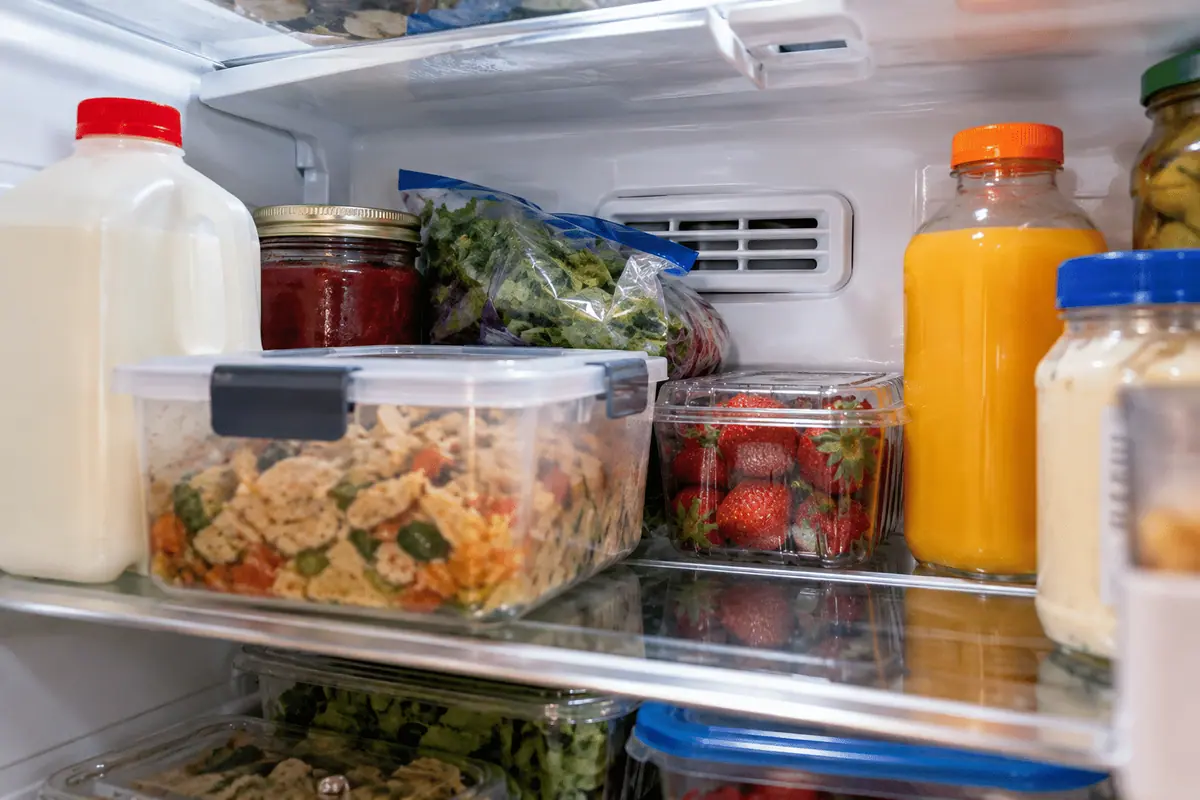
The same problem can happen on the freezer side. If a bag of frozen food is pushed tightly against the air outlet, less cold air reaches the refrigerator. Over time, the fresh-food temperature climbs.
Air also needs a return path. Refrigerators are designed with circulation in mind, so blocking lower vents or stuffing shelves completely full can create dead zones where warm air collects.
This issue often appears after a grocery trip. The refrigerator worked perfectly the day before, then you filled every shelf and suddenly noticed that drinks were not getting as cold. That timing is a useful clue.
Try reorganizing the food. Leave visible space around vents and avoid stacking containers tightly against the back wall. You do not need to make the refrigerator look empty. You simply need to give air enough room to move.
After rearranging, give the appliance time to stabilize. Refrigerator temperatures do not change instantly. Depending on how warm the compartment became and how much food is inside, it may take several hours to return to normal.
You can also place a refrigerator thermometer in the center area to track improvement rather than relying only on how cold a bottle feels.
If cooling improves after opening the airflow paths, you have probably found the problem.
This is a good reminder that a refrigerator is not just a cold box. It is an air-moving system. The shelves, vents, and ducts all depend on having enough open space to circulate cold air.
Before replacing a fan, sensor, or control board, make sure the cold air simply is not trapped behind yesterday’s groceries.
Too Much Food Can Restrict Airflow Inside the Refrigerator
A full refrigerator can actually operate efficiently because chilled food helps stabilize temperature. But there is a difference between “well stocked” and “packed so tightly that air cannot move.”
When every shelf is loaded from front to back and containers touch the walls, the internal fan cannot distribute cold air evenly. You may end up with very cold spots near vents and warm pockets in corners or toward the front.
Large containers are especially good at blocking air. A deep casserole dish, party tray, or oversized produce bin can act almost like a wall inside the compartment.
Overloading the freezer can create an even bigger problem because the freezer is often where the refrigerator’s cold air originates. If frozen packages cover the vent system, very little cold air may make it into the refrigerator section.
One clue is uneven food temperature. Items near the vent may feel almost frozen while items on the opposite side feel too warm. Another clue is that the refrigerator cools better after you remove some food.
Try creating small channels between containers so air can move around them. Keep food a little away from the rear wall and avoid stacking items directly over vents.
Do not confuse airflow problems with capacity problems. A refrigerator should be able to handle a normal household load, but it cannot overcome a completely blocked circulation system.
The freezer should also not be so packed that drawers cannot close correctly. A drawer left slightly open can interfere with internal airflow and may also affect the door seal.
Fresh groceries add heat too. If you load the refrigerator with many room-temperature drinks or containers at once, the appliance may need several hours to recover. That temporary temperature rise does not necessarily mean anything is broken.
The useful question is whether the refrigerator cools back down after the load stabilizes.
If it remains warm for many hours even after you open the vents and reduce overcrowding, move on to the next possibilities.
A refrigerator works best when cold air can move around the food, not just at the food. Leaving some breathing room is one of the simplest DIY ways to restore even cooling.
Frost Buildup Can Block the Evaporator and Air Passages
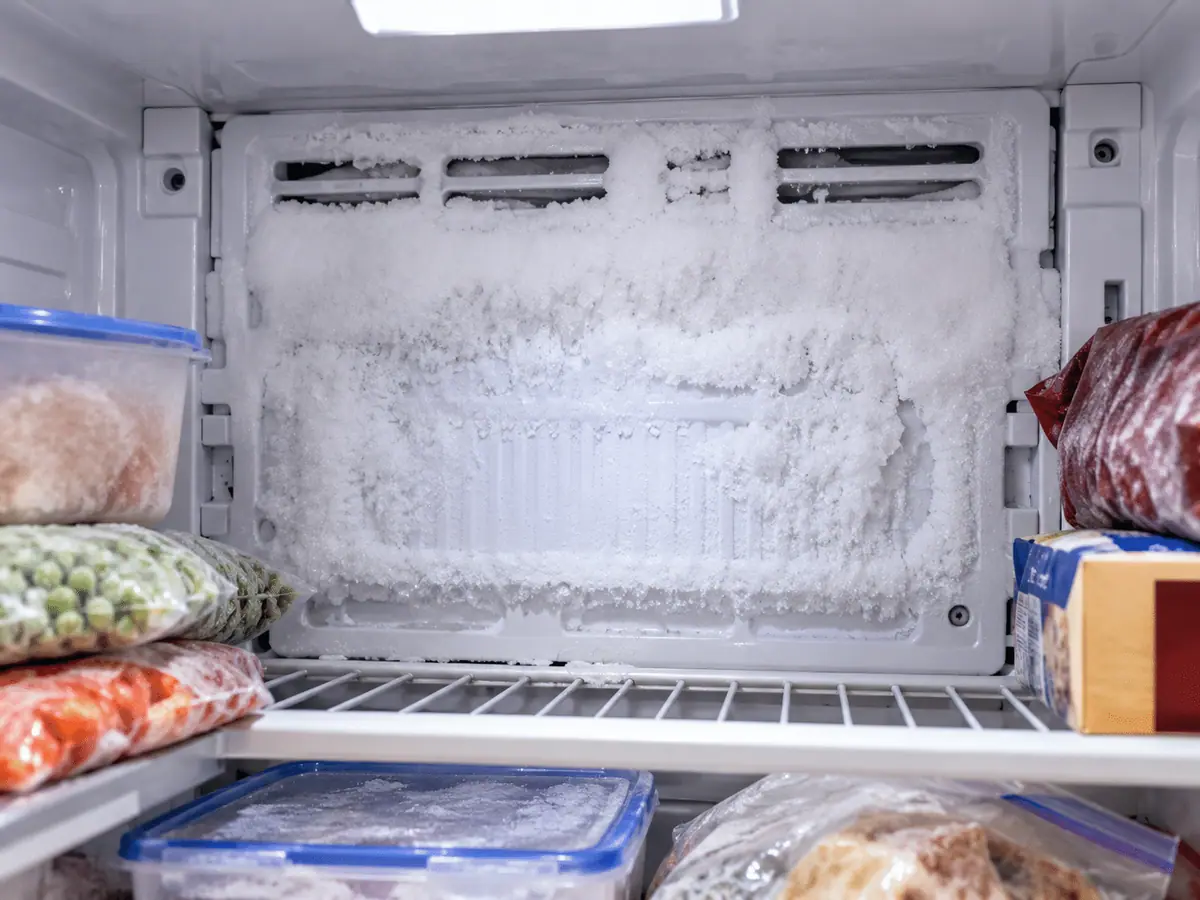
If the freezer is still cold but the refrigerator is warm, frost buildup is one of the most important things to look for. A thick layer of frost behind the freezer’s rear interior panel can block the airflow that supplies the fresh-food section.
The confusing part is that the freezer may still feel very cold. In fact, it can look like the freezer is working “too well.” You may see snow-like frost, icy buildup, or a solid white layer across the rear wall.
What is happening behind that panel is often more important than what you can see. The evaporator coil is supposed to get very cold, and some frost formation during normal operation is expected. The automatic defrost system periodically melts that frost.
If the frost is not removed, it gradually becomes thicker. Eventually it covers the evaporator and air channels. The fan can no longer move air through the coil efficiently. The freezer remains cold near the evaporator, but the refrigerator loses its supply of circulating cold air. If you are seeing this type of buildup, our guide to freezer ice buildup explains the common causes and what to check.
You may also hear a scraping or clicking noise if the evaporator fan begins touching ice.
A temporary DIY test is a complete defrost. Unplug the refrigerator, move food to a safe cold location, open the doors, and allow the appliance to thaw fully. Place towels around the base because a surprising amount of water can come from hidden frost.
Do not use knives, screwdrivers, or other sharp objects to chip ice away. Refrigerant tubing and other components can sit behind the interior panels.
After the refrigerator is fully thawed and restarted, watch what happens. If the fresh-food section cools normally again for several days or weeks and then slowly becomes warm while the freezer frosts up, that pattern strongly suggests an automatic defrost problem.
A manual defrost removes the symptom, but it does not necessarily fix the cause.
This is why recurring heavy frost matters. It tells you that the cooling system may still be producing cold air, but the system responsible for managing frost is not keeping the airflow path open.
A Failed Evaporator Fan Can Leave the Refrigerator Warm
The evaporator fan is one of the most important parts in a refrigerator that shares cold air between the freezer and fresh-food compartments. Its job is to move air across the cold evaporator coil and push that air through the freezer and refrigerator ducts.
If the fan stops working, the freezer may still remain cold near the coil because the evaporator itself is cold. The refrigerator, however, may warm up quickly because there is no fan moving cold air into it.
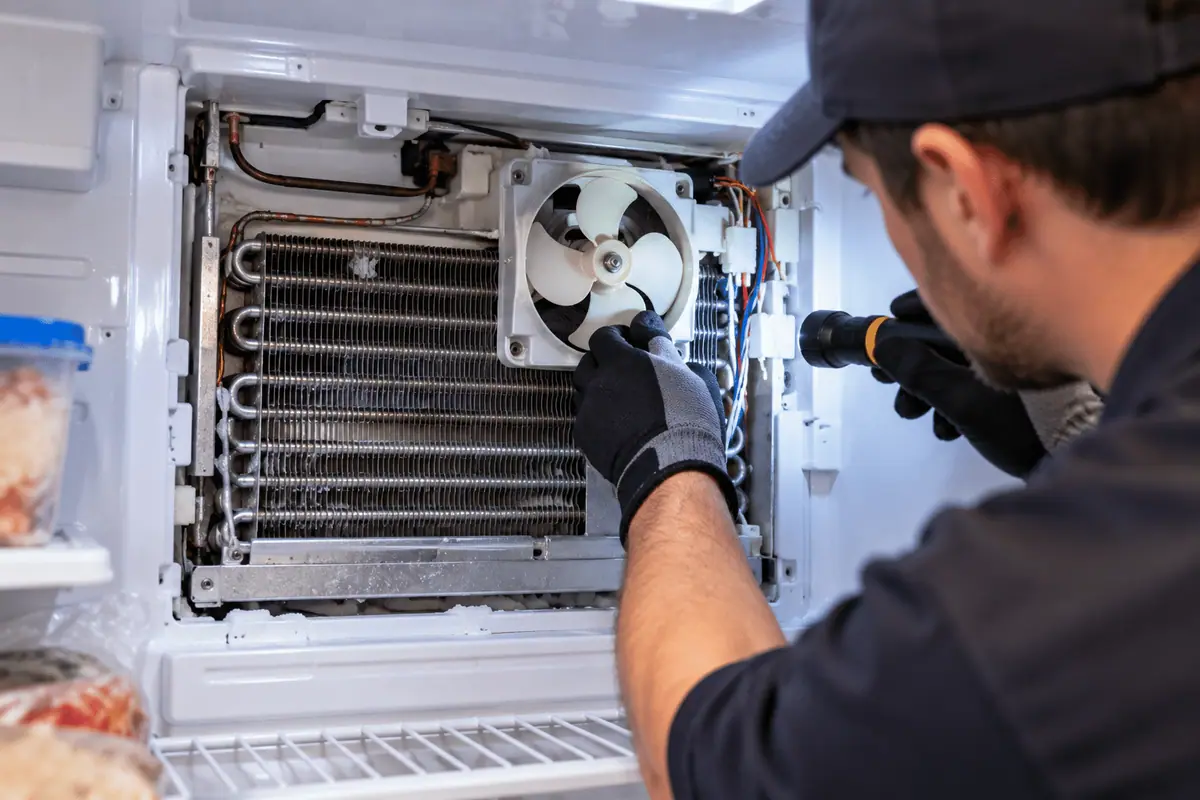
Listen carefully when the refrigerator is running. In many models, you should hear a soft fan sound from the freezer area. Depending on the design, the fan may stop when the freezer door is opened. That means you might need to listen just before opening the door or press the door switch only if it is safe and obvious to do so.
If you hear no fan at all while the compressor is running, the evaporator fan deserves attention.
You may also hear unusual noises. A failing fan motor can squeal, buzz, click, or start and stop. Ice can also interfere with the fan blades, creating a repetitive scraping sound.
With the refrigerator unplugged, inspect the accessible fan area if it can be reached without major disassembly. Look for ice around the blades, damaged plastic, or obvious obstruction.
Never put your fingers near a fan while the refrigerator is powered.
A fan can fail electrically even when the blades look fine. Testing the motor may require a multimeter and access to wiring.
Before replacing the fan, make sure the problem is not simply ice blocking it. If a complete defrost restores fan operation, you may have a defrost issue rather than a bad motor.
One practical clue is how the freezer itself feels. If food near the back wall is extremely cold but temperatures toward the door are less consistent, weak circulation may be part of the problem.
A refrigerator depends on moving cold air, not merely creating it. That is why a failed evaporator fan can produce the strange combination of a cold freezer and warm refrigerator.
The Air Damper May Be Stuck Closed
Many refrigerators use an air damper or air-control door between the freezer and refrigerator sections. This small component regulates how much cold air enters the fresh-food compartment.
When the refrigerator needs more cooling, the damper opens. When the temperature is low enough, it closes or partially closes.
If the damper becomes stuck shut, cold air stays in the freezer and the refrigerator gradually warms.
The damper is usually located near one of the upper air vents in the fresh-food section, though designs vary. You may be able to hear or feel air movement at that vent when the refrigerator is actively cooling.
Place your hand near the vent without blocking it. You should usually feel a stream of cool air at least some of the time. If the freezer is running and cold but there is almost no airflow into the refrigerator, the damper or upstream airflow system deserves investigation.
Ice can sometimes freeze the damper in place. Food packages may also physically obstruct the area.
A mechanical damper can stick due to wear or damage. Electronically controlled dampers can fail because of a motor, sensor, or control problem.
Do not force the damper open with a tool. Plastic components can crack easily, and damaging the door may create a new temperature-control problem.
If frost is present around the vent, a full defrost can help determine whether ice was the cause. If the damper works normally after thawing but freezes again later, the underlying moisture or defrost issue still needs attention.
A stuck-open damper creates the opposite problem: the refrigerator can become too cold, and food may freeze. A stuck-closed damper gives you the exact symptom we are discussing—freezer cold, refrigerator warm.
This is one of those parts that is easy to overlook because the compressor can be running normally and the freezer can look perfect.
The cooling system may be doing its job. The door that allows cold air into the refrigerator simply is not opening when it should.
Dirty Condenser Coils Can Reduce Overall Cooling Performance
Condenser coils release heat from the refrigeration system. Depending on the refrigerator design, they may be behind the appliance, underneath it, or integrated into the cabinet structure.
When accessible condenser coils become covered with dust, pet hair, grease, and household debris, they cannot release heat as efficiently.
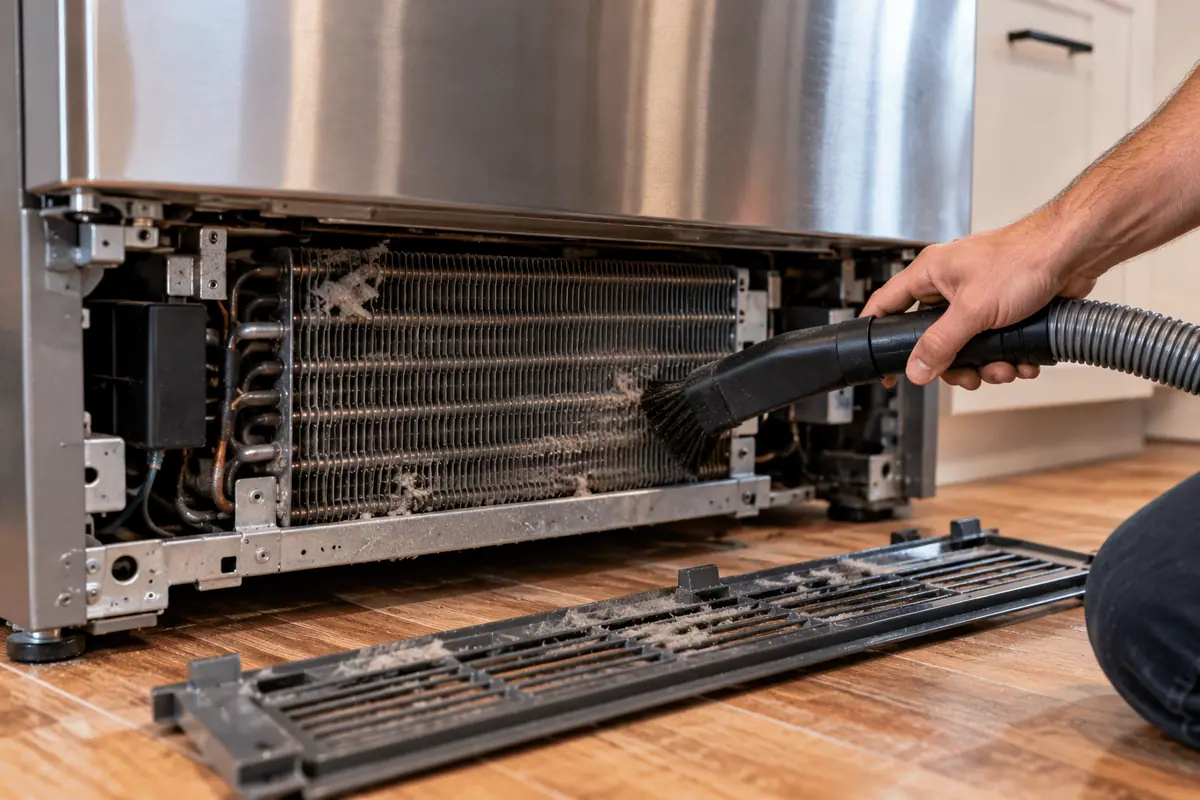
The refrigerator then has to work harder to move heat from inside the cabinet into the room.
At first, the freezer may still maintain acceptable temperatures while the refrigerator section begins to struggle. This is especially likely in hot weather, after heavy grocery loading, or when other airflow problems are present.
If your refrigerator has accessible coils, unplug the appliance before cleaning them. Use a coil brush or vacuum attachment to remove loose dust. Be careful around thin metal tubing and wiring.
Do not bend refrigerant lines or aggressively scrape the coils.
If the coils are underneath the refrigerator, remove the lower grille only if it is designed for homeowner access. You may be surprised by how much dust collects there, especially in homes with pets.
Also check that the area around the condenser fan, if present, is not packed with debris.
Cleaning the coils will not fix a broken fan or failed defrost system, but it can improve overall cooling efficiency.
A useful clue is compressor run time. If the refrigerator seems to run almost constantly, feels unusually warm around the lower rear area, and the fresh-food section is not reaching temperature, poor heat rejection may be part of the problem.
Room temperature matters too. Dirty coils are much more likely to cause noticeable trouble in a hot kitchen than in a cool room.
Think of the condenser like the radiator in a car. If it cannot get rid of heat, the entire system becomes less efficient.
This is one of the easiest preventive maintenance tasks you can do yourself, and it is worth checking before assuming the refrigerator has a serious refrigeration failure.
A cold freezer with a warm fridge can absolutely start as an airflow problem inside the cabinet, but poor heat release outside the cabinet can make that imbalance worse.
A Door Gasket Leak Can Let Warm Air Into the Refrigerator
The fresh-food door seal has one simple job: keep cold air inside and warm, humid room air outside. If that seal develops a gap, the refrigerator may struggle to maintain temperature even while the freezer stays cold.
The door gasket can become dirty, warped, hardened, torn, or compressed over time. Food containers can also prevent the door from closing completely.
Start by looking at the gasket around the entire perimeter. Clean sticky residue with warm water and mild dish soap. Make sure crumbs or hardened spills are not holding the gasket away from the cabinet.
Then perform the paper test. Close the door on a strip of paper and gently pull. You should feel resistance. Repeat this test around several areas of the door.
If the paper slides out very easily in one section, that part of the gasket may not be sealing properly.
Look at the door alignment too. If one corner appears lower than the other, hinge wear or cabinet leveling can interfere with sealing.
A gasket leak often creates other clues. You may see condensation, moisture around the door, or frost near an air passage. The refrigerator may run more often because it is constantly fighting incoming warm air.
Warm room air carries moisture. When that moisture enters the refrigerator, it condenses on cold surfaces. This can add to frost buildup and create secondary airflow problems.
Do not immediately assume the gasket itself needs replacement. Sometimes cleaning and adjusting food placement is enough.
Make sure no drawer is sticking out and no large bottle or container is preventing full closure.
Also check how the refrigerator sits. An appliance that is badly tilted can affect door closing.
The freezer may appear fine because its door seals correctly or because the freezer has greater cooling capacity. Meanwhile, the refrigerator section quietly loses cold air all day.
A good door seal is one of the simplest things to inspect and one of the most important for maintaining stable temperature.
When troubleshooting a refrigerator that is warm while the freezer works, do not overlook the obvious barrier between the cold compartment and your kitchen.
Incorrect Temperature Settings Can Cause Uneven Cooling
Sometimes a temperature problem starts with nothing more complicated than a control setting.
If someone accidentally adjusted the refrigerator control warmer, the fresh-food section may slowly rise above the safe range even though the freezer remains frozen.
This can happen after cleaning, rearranging shelves, or pushing food against a control dial. Digital controls can also be changed unintentionally.
Check both freezer and refrigerator settings. Do not assume that a lower number always means colder. On some dials, higher numbers mean more cooling; on others, the labeling may work differently.
Use a thermometer rather than relying entirely on the control position.
As a general target, the refrigerator should stay around 37°F to 40°F, while the freezer should remain around 0°F.
Avoid turning the refrigerator to the coldest possible setting as your first troubleshooting move. If an airflow or defrost problem exists, maximum cooling does not fix it. It simply makes the compressor run longer.
Temperature settings can also interact. In some designs, changing the freezer control affects how much cold air is distributed to the refrigerator section.
Give the appliance enough time after making an adjustment. Temperatures do not stabilize immediately. Wait several hours before deciding whether a small change worked.
Also avoid making multiple adjustments back and forth. That makes diagnosis harder because the refrigerator never reaches a stable operating condition.
If the refrigerator is warm but the freezer is extremely cold, pay attention to the airflow controls rather than assuming the entire system needs “more cold.”
A control set incorrectly can sometimes make this imbalance worse.
External temperature displays are useful, but they do not always tell you the temperature of the food itself. A simple refrigerator thermometer placed in the center of the compartment gives a better real-world picture.
Use the thermometer over several hours rather than checking immediately after opening the door.
The goal is not to chase a perfect number every minute. Refrigerators naturally cycle.
The important thing is whether the average temperature stays within a safe range.
Before replacing anything, confirm that the appliance is being asked to cool to the temperature you actually want. Incorrect settings are easy to fix and easy to overlook.
A Temperature Sensor or Thermostat May Be Giving Bad Readings
Modern refrigerators use temperature sensors, often called thermistors, to tell the control board how cold each compartment is.
If a sensor gives an incorrect reading, the refrigerator may think the fresh-food section is colder than it really is. The control system may reduce cooling or close a damper too early.
Older refrigerators may use mechanical thermostats instead of electronic sensors, but the basic idea is similar. The control needs accurate temperature information to know when to cool.
Sensor problems can be difficult to diagnose without testing because the refrigerator may still run and the freezer may still freeze normally.
Watch for inconsistent behavior. The refrigerator may sometimes cool correctly and then become warm for no obvious reason. Adjusting the control may have little effect.
A thermometer is especially useful here. If the display says 37°F but an independent thermometer consistently shows 48°F, something in the sensing or control system may be inaccurate.
Do not assume the sensor is bad just because the displayed temperature is different immediately after opening the door. Give the compartment time to stabilize.
Some sensors can be tested with a multimeter by measuring resistance and comparing the reading to a temperature-resistance chart for that specific model.
Do not use a generic resistance value from another refrigerator. Thermistors can have different specifications.
Also inspect visible sensor housings for damage or ice buildup. A sensor trapped in ice may respond differently than expected.
If the sensor appears normal but the control system is not responding correctly, the issue could involve wiring or the main control board.
This is where random part replacement becomes expensive. A new thermistor will not fix a broken wire, and a new control board will not fix a frozen air duct.
Use symptoms to narrow the problem before ordering anything.
A cold freezer and warm refrigerator can absolutely be caused by incorrect temperature feedback, but simpler airflow causes should usually be checked first.
A Defrost System Problem Can Slowly Choke Off Airflow
Automatic defrost systems are designed to keep the evaporator coil from becoming buried in frost.
During normal operation, moisture in the air freezes on the cold evaporator. The refrigerator periodically enters a defrost cycle, warms the coil enough to melt the frost, and drains the water away.
If any part of that process fails, frost accumulates day after day.
Eventually, the evaporator becomes covered with ice. Air can no longer pass through it efficiently. The evaporator fan may still run, but it is trying to pull air through a wall of frost.
This is one of the classic reasons the freezer remains cold while the refrigerator warms.
Possible causes include a failed defrost heater, defrost thermostat, temperature sensor, wiring problem, or electronic control issue.
The exact components depend on the refrigerator design.
A strong clue is the timeline. The refrigerator may work normally after being unplugged and fully thawed. Then, over the next several days or weeks, the refrigerator section gradually becomes warmer again.
You may notice frost returning to the freezer’s rear interior panel.
That repeating pattern is much more useful than simply saying, “The refrigerator is not cold.”
A full manual defrost can temporarily restore airflow because it removes the ice. But if the automatic defrost system is not working, the frost will return.
Testing defrost components usually requires access behind the freezer panel and electrical measurements.
Unplug the refrigerator before removing panels or disconnecting components.
A defrost heater can sometimes be checked for continuity. Sensors and thermostats require model-specific testing procedures.
The control board is harder to diagnose because it manages timing and power to multiple components.
Do not replace the board simply because the refrigerator has a defrost problem. Confirm the heater, sensor, thermostat, wiring, and frost pattern first.
Also remember that not every frosted evaporator means a failed defrost system. A door left open for hours can introduce enough moisture to create heavy frost.
That is why the problem’s history matters.
If the frost returns repeatedly under normal use, the automatic defrost system becomes a much stronger suspect.
A Freezer That Is Too Full Can Make the Refrigerator Warmer
The freezer needs airflow just as much as the refrigerator section does.
When frozen food is packed tightly around vents, the evaporator fan cannot circulate cold air correctly. The freezer may still feel cold because the food itself is frozen, but very little air may be moving into the refrigerator.
This is especially common after buying groceries in bulk.
Large bags of frozen food can cover rear vents. Boxes can press against the back panel. Items can also prevent drawers from closing completely.
Look for air outlets and return vents inside the freezer. Make sure they are not covered.
Do not stack food directly against the evaporator cover.
If you cannot see any open space around the back wall, the freezer is probably too crowded for ideal circulation.
Try removing or reorganizing some items. Leave small gaps between packages and keep the vent areas clear.
Then monitor the refrigerator temperature over the next several hours.
If cooling improves, airflow restriction was likely contributing to the problem.
A freezer does not need to be half empty. In fact, frozen food helps maintain temperature when the door opens.
The goal is simply to avoid blocking the designed airflow path.
Also check for loose plastic bags. A lightweight bag can be pulled against an air inlet when the fan runs, acting like a temporary blockage.
The problem may disappear when the door opens because the fan stops and the bag falls away. That can make the issue surprisingly difficult to spot.
Ice buildup around packages can also indicate that warm, humid air has been entering through a door that did not close fully.
Make sure food is not physically preventing the freezer door from sealing.
If reorganizing the freezer restores refrigerator cooling, you have found a simple problem that could easily have looked like a major repair.
This is why airflow checks should come before expensive parts.
The refrigerator cannot cool properly if the cold air has no clear path from the evaporator to the fresh-food compartment.
How to Troubleshoot a Warm Refrigerator Yourself
When the freezer is cold but the refrigerator is warm, work through the problem in a logical order.
Start with the easiest things first.
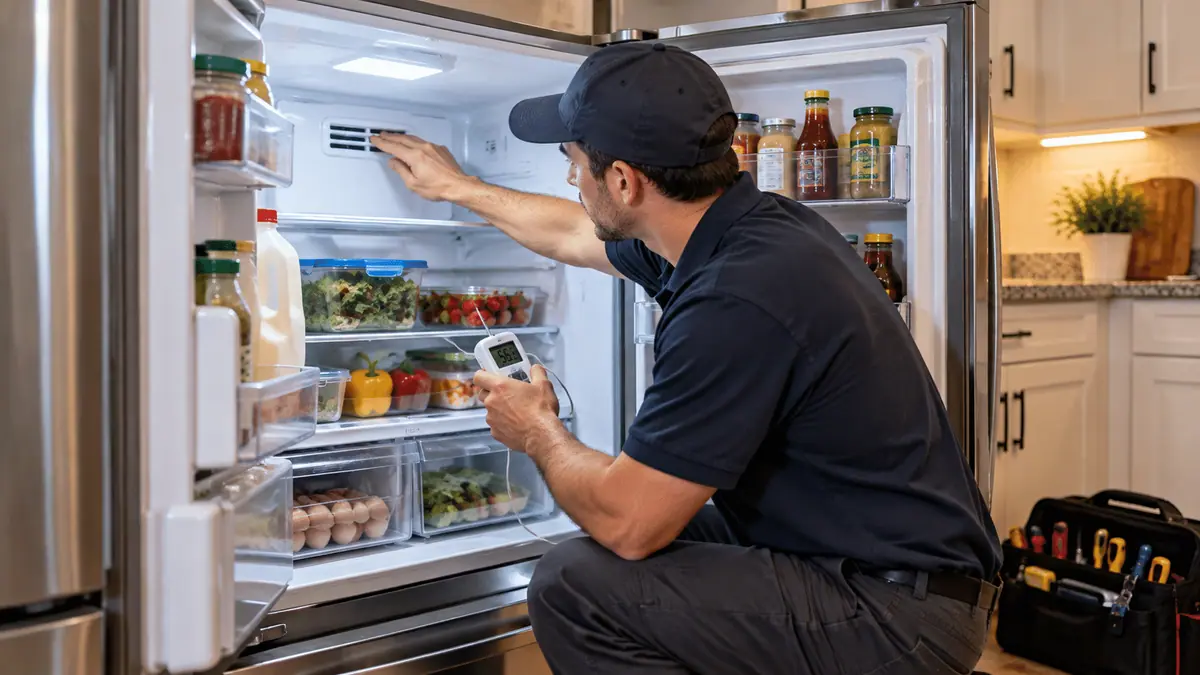
Check the refrigerator temperature with a thermometer. Do not rely only on how the food feels.
Then inspect the air vents in both compartments. Move food away from the openings and create space for circulation.
Listen for the evaporator fan. If the freezer is cold but you never hear the fan running, that is an important clue.
Look at the freezer’s rear interior panel. Heavy frost or snow-like buildup suggests restricted airflow and possibly a defrost problem.
Check the refrigerator door gasket. Clean it and make sure the door closes completely.
Inspect the temperature settings. Confirm that no one accidentally changed them.
If your refrigerator has accessible condenser coils, unplug the appliance and clean the dust from them.
After making simple corrections, give the refrigerator several hours to respond.
Do not change five things at once if you are trying to identify the cause. Make one or two reasonable changes and observe the result.
If you suspect frost blockage, a full manual defrost can be a useful diagnostic step.
Move food to another refrigerator, freezer, or insulated cooler. Unplug the appliance and leave the doors open long enough for hidden ice to melt completely.
Protect the floor with towels.
After restarting the refrigerator, monitor both compartments.
If normal cooling returns and then fails again after several days or weeks, you have learned something important. The refrigeration system can produce cold air, but frost is likely returning and restricting airflow.
If the refrigerator remains warm immediately after a complete defrost, look more closely at the fan, damper, sensor, or overall cooling performance.
Pay attention to sounds and timing. Does the compressor run? Does the fan run? Does the problem appear after loading groceries? Did it begin after the door was left open?
These details can narrow the diagnosis dramatically.
The best troubleshooting process is not guessing which part is bad.
It is observing what the refrigerator is doing, eliminating simple causes, and following the evidence.
When a Warm Refrigerator Points to a Bigger Cooling Problem
A cold freezer and warm refrigerator usually makes you think about airflow first, but not every case is simple.
Sometimes the freezer is only partially cold. Ice cream may be soft, frozen food may not feel solid, or the freezer temperature may be well above 0°F even though it still feels “cold” to your hand.
That changes the diagnosis.
If both compartments are gradually warming, the refrigerator may have a broader cooling problem.
Possible causes include a weak compressor, refrigerant leak, restricted sealed system, condenser fan failure, or control issue.
A refrigerator can also create the illusion of a working freezer because frozen food stays cold for a long time even after cooling performance drops.
Use a thermometer to verify the actual freezer temperature.
If the freezer is 15°F or 20°F, it is not operating normally even though the food has not completely thawed.
Another warning sign is a compressor that runs almost constantly without bringing temperatures down.
Very little frost on the evaporator can also point toward a sealed-system issue, but viewing the evaporator usually requires removing an interior panel.
An uneven frost pattern can be meaningful as well. A healthy evaporator often develops a relatively even light frost pattern during active cooling. Frost only on one small section can suggest a refrigeration-system problem.
Sealed-system work requires specialized tools and refrigerant handling knowledge.
Do not cut refrigerant lines or attempt to add refrigerant as a DIY experiment.
Refrigerators do not normally “use up” refrigerant. If the charge is low, there is usually a leak or another system issue that needs to be diagnosed.
This is the point where professional testing becomes much more valuable. Our guide to signs your refrigerator needs professional repair can also help you determine when basic troubleshooting is no longer enough.
A technician can check operating temperatures, fan operation, compressor behavior, electrical components, and the evaporator frost pattern to determine whether the problem is airflow-related or part of the refrigeration system.
The key is knowing when the symptoms no longer fit a simple blocked vent or frost issue.
If the freezer itself cannot maintain the correct temperature, expand your diagnosis beyond refrigerator airflow.
Conclusion
A refrigerator that is warm while the freezer still works is one of those problems that seems mysterious until you understand how the two compartments share cold air.
In many cases, the refrigerator section is not failing because the appliance cannot make cold air. It is failing because that cold air is not reaching the fresh-food compartment properly.
Start with airflow.
Check for blocked vents, overcrowded shelves, a packed freezer, and food containers pressed against air passages.
Look for frost buildup on the freezer’s rear panel.
Listen for the evaporator fan.
Check whether cold air is coming through the refrigerator vent.
Inspect the door gasket and confirm the temperature settings.
Clean accessible condenser coils.
Use a thermometer to verify what the appliance is actually doing.
If a full defrost temporarily restores normal cooling and the problem returns later, investigate the automatic defrost system.
If the freezer is not truly maintaining freezing temperatures, the problem may extend beyond airflow and into the main refrigeration system.
Most importantly, do not replace parts based on guesses.
A warm refrigerator and cold freezer is a symptom pattern, not a diagnosis.
Follow the airflow path, observe the frost pattern, listen to the fans, and pay attention to how the temperatures change over time.
Those clues usually tell you where to look next.